


What Happens to Life Insurance if Health Circumstances Change?
Many people worry what the impact of changing health circumstances will be on their life […]

If your current health insurance provider isn’t meeting your communication, care, or coverage needs, you may be considering changing health insurance providers.
A common worry when doing so is that care will be disrupted, and you may lose access to trusted medical specialists. This doesn’t need to be the case, even if you’ve got pre-existing conditions or complex medical needs.

When you switch health insurance policies, it’s possible that you may run into issues such as early-cancellation fees, increased premiums or delayed access to care.
Whilst all these risks are very real, they are manageable and don’t mean that switching isn’t the best option. Working with a trusted health insurance intermediary such as Dragonfly Crowd means we’ll explain all your options, and all the technicalities you may or may not face. This includes understanding the impact on your ongoing care, and how best to maintain care whilst switching you to a more suitable provider.
Get Bespoke Health Insurance Advice
Yes, you can change health insurance providers without losing cover. The best way to do so is by working with an insurance specialist, who can conduct an in-depth review of your current policy and research how other insurers would underwrite, and how this would be impacted by your existing conditions.
We can also research every policy option, cross-referencing medical consultants and clinic lists between insurers, making sure to find options which remove the need to wait for new referrals or switch doctors. This is the best way to change health insurance without losing cover.
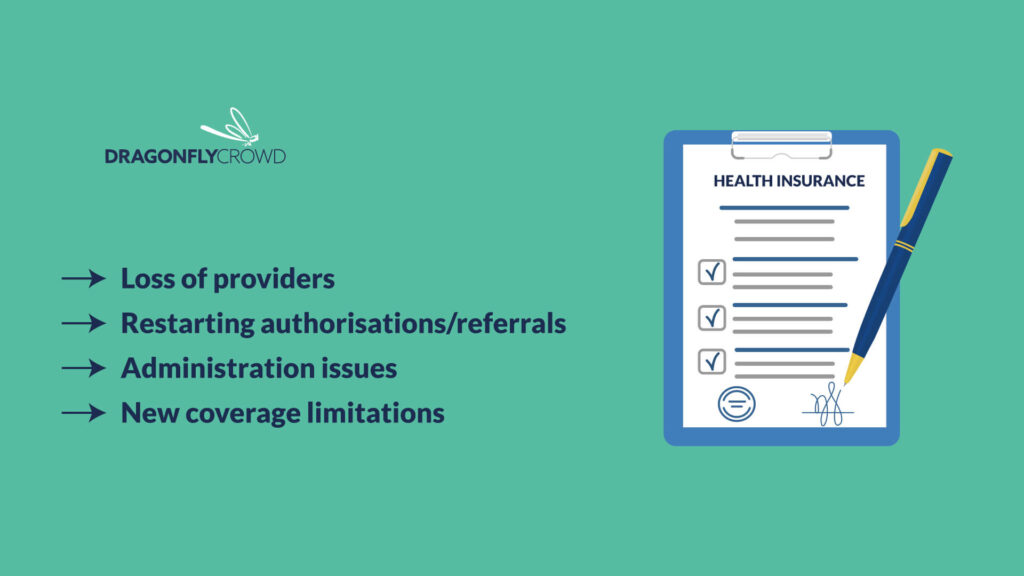
Changing health insurance can affect care continuity because different insurers work with different healthcare providers, and offer varying levels of coverage:
The key to avoiding all of these issues is understanding exactly what your old/new policy offers, and knowing how to seamlessly transfer from one provider to another. That’s where working with an intermediary is so vital, to offload the administrative burden and find out exactly how your care can be continued without disruption.
Continuity of care in insurance includes allowing patients to continue seeing their primary healthcare provider or doctor whilst changing plans. This would involve a smooth transition with limited to no disruptions, or sharing medical records efficiently to ensure that patients don’t have to provide their medical history from scratch with a new provider.
The Dragonfly Crowd team worked with a family who had faced two major health events, including a cancer diagnosis and a severe eye condition. Through deep research, we were able to help this family move their policy, improving premiums and maintaining existing specialist care, despite the existing medical difficulties.
You may also need to disclose medication you regularly take, hospital visits, referrals and even family history related to the condition (if any). This can be difficult to remember/pull together (such as finding condition details, impact, medical and family history), but being guided through the process by an expert team can really help.
To find out more on how Dragonfly Crowd can help you secure the most appropriate life insurance for your circumstances, give us a call on 01204 866902.

Yes, you can switch health insurance providers if you are currently having treatment, but it can come with complications and considerations. You need to be sure that your new insurer will cover the same things as your current one (or more things if that’s your reason for switching).
If you’re currently receiving treatment, you also need to ensure that the care transition will be coordinated so that you don’t end up without any care or treatment for a period of time. This is where we can help.
Switch Medical Insurers with No Hassle or Worry
The safest way to switch medical insurance providers is by working with a trusted intermediary, who will conduct the relevant market research and communicate with you and your old/new insurers to ensure that care is maintained.
Managing this transition process alone, especially if dealing with medical issues, can be confusing and exhausting. This can lead to errors or misunderstandings which result in missed/lost care.
Get in touch with Dragonfly Crowd today to safely switch health insurers without interrupting your current care.

Many people worry what the impact of changing health circumstances will be on their life […]


Pre-existing conditions can have an impact on available coverage and premium costs of life insurance […]


A cancer diagnosis is a shock to anybody, and it’s incredibly difficult to navigate the […]


Simply provide us with your information, and we'll promptly get in touch (typically within 24 hours on weekdays) to discuss your health insurance requirements. Afterward, we'll follow up with your complimentary quote (usually within a week).