



What is Group Income Protection? An Employer’s Guide
Group income protection provides a safety net when your employees cannot work because of illness or injury.

Income protection provides a financial safety net for workers who can’t work because of illness or injury. Arranging this coverage individually can be challenging because of an existing medical history, but workplace group income protection offers another option.
Workplace coverage makes this type of coverage more accessible, and with half of UK workers now seeing these policies as vital, it’s becoming an increasingly popular workplace benefit.
In this guide, we discuss the true value of group schemes and how they can provide vital coverage when individual income protection creates unnecessary barriers.
It’s all down to the process of taking out income protection policies. Taking out an individual policy usually requires medical underwriting, an assessment of the applicant’s health history.
Insurers use medical underwriting to decide what cover they’ll offer and the terms they’re willing to provide it on. Depending on an employee’s circumstances, it could lead to exclusions and higher premiums that they wouldn’t have to contend with if they got the same coverage via their workplace.
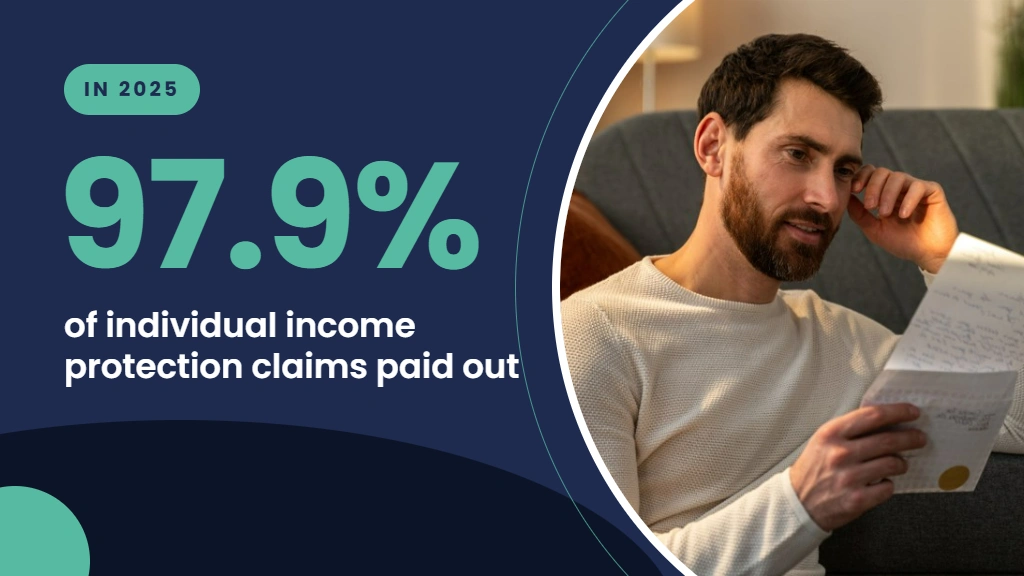
Despite 97.9% of individual income protection claims being paid out in 2025, this doesn’t account for those who weren’t offered an acceptable individual policy in the first place. Interestingly, though, the terms of an individual policy don’t mean an employee can’t get coverage through their employer because the group scheme approach differs.
Employers arrange policies for all eligible employees under the agreed rules of the scheme. This is highly beneficial because covered employees don’t need an individual medical underwriting assessment. Effectively, it means that if a worker was denied an individual income protection policy, they could still get similar coverage via their employer’s group income protection.
Of course, every group income protection scheme still has overarching conditions. Each of your employees still has to meet those eligibility requirements, such as being ‘actively at work’ to qualify. The difference is there’s no individual medical underwriting involved.
The differences between individual income protection vs. group income protection aren’t an insurer oversight. Group schemes are more flexible because of the defined benefit structure. Automatic acceptance for eligible employees spreads risk across larger groups, reducing claims risk for the insurer.
Compared with the time and cost of individually assessing every covered employee, this makes sense from an insurance perspective. This is also why larger schemes tend to have higher free cover limits and overall lower premiums.
In other words, it’s a much more straightforward process than opting for individual income protection.
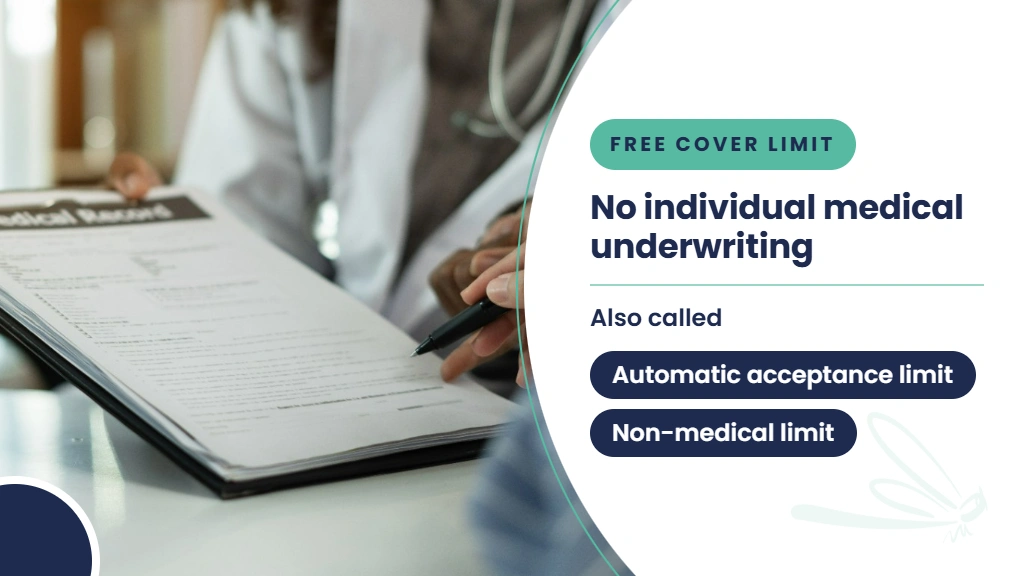
Free cover limits are the maximum insured benefit available to each employee without going through individual medical underwriting. You may see this referred to as an automatic acceptance limit or a non-medical limit.
Note that this relates to the insured income benefit, rather than the employee’s salary. Free simply refers to not having an individual medical underwriting process, as opposed to the overall cost of the policy.
Free cover limits depend on the insurer and the scheme in question. The number of covered employees and salary levels will come into play. The latter is especially important because workers on higher salaries may exceed the automatic acceptance threshold. That’s one reason why senior staff often have dedicated executive income protection policies in place.
As an employer, it’s important to compare:
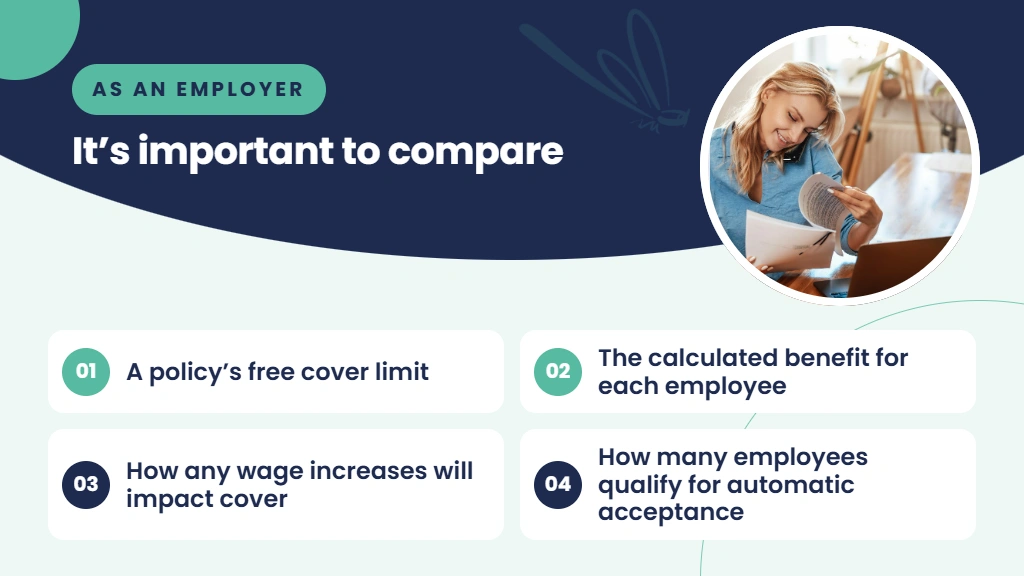
It’s all part of the comparison process. That’s why consulting with an insurance intermediary from Dragonfly Crowd can be immensely helpful in making all of the necessary calculations and sourcing the right policy for your organisation.
In this scenario, the insurer will usually request extra medical information to confirm cover above the limit. Depending on the outcome, this could mean paying extra premiums or dealing with specific exclusions.
Nevertheless, whatever happens regarding additional cover, this won’t automatically mean that the protection guaranteed below the limit disappears. Employees can still retain this cover, even if an insurer isn’t willing to cover the excess.
Your employee’s situation will depend on how your insurer approaches the issue of medical underwriting. Typically, insurers may request a tailored assessment if:
Every insurer sets its own rules for this. That’s why it’s vital to run through a policy’s terms and conditions and speak to an expert before committing to any single policy.
Some policies will cover pre-existing conditions. If your employee already qualifies under the free cover limits, any pre-existing conditions are usually included without any extra assessment. Any cover above the limit may invite exclusions depending on the insurer.
On a side note, insurers treat pre-existing conditions differently depending on whether they’re simply part of a worker’s medical history or already stopping them from working.
Being actively at work means that an employee can carry out their normal duties for their set hours. Just because a worker is employed or attends work won’t always satisfy the definition.
Someone who doesn’t meet the requirement when cover is expected to kick in may have a waiting period before they can claim. You’ll need to look into the exact terms if an employee is already returning after an absence or they’re working on adjusted or reduced duties.
You’ll quickly notice that policy wording is critical to various aspects of the group income protection system, and every insurer is free to construct their policies as they see fit.
The last thing you want is to be trawling through pages of legalese, and this is where an insurance intermediary like Dragonfly Crowd comes in. We take the time to get to know your company and its people before sifting through a wide panel of insurers to source the right policy for you.
If you’d like to learn more about getting the group income protection that suits your team, contact Dragonfly Crowd now.
Group income protection provides a safety net when your employees cannot work because of illness or injury.


Long-term employee well-being is about standing by them when life takes an unexpected turn. It’s […]


Group critical illness cover is there to provide employees with a lump sum payout entirely […]


Simply provide us with your information, and we'll promptly get in touch (typically within 24 hours on weekdays) to discuss your health insurance requirements. Afterward, we'll follow up with your complimentary quote (usually within a week).